Rawalpindi Medical University (RMU) is a non-profit public sector institution located in Rawalpindi, Punjab. It is recognized by the Higher Education Commission of Pakistan and the Pakistan Medical and Dental Council (PMDC). Serving a population of 1 to 5 million, RMU is a small-sized coeducational university with an enrollment of approximately 3,000–3,999 students, as per uniRank.
The university is affiliated with three hospitals: Holy Family Hospital, Benazir Bhutto Hospital, and Rawalpindi Teaching Hospital. The Department of Obstetrics & Gynecology at Holy Family Hospital consists of two units. Unit-I is led by Dean Prof. Tallat Farkhanda, while Unit-II is headed by Prof. Humera Noreen. Gynae Unit-II at Holy Family Hospital has 120 beds (49,548 seen in OPD and 19502 patients seen in Gynae emergency and 6,637 maternities) and functions as a referral center for complex cases from various regions, including Chakwal, Murree, Attock, Sargodha, Mianwali, and Azad Kashmir (Bagh).
It serves as a center for advanced and complex obstetric and gynecological care, handling high-risk obstetric emergencies and critical referrals from the surrounding regions of Rawalpindi. Its gynecological services include the management of subfertility, urogynecology, gynecologic oncology, and minimally invasive surgery. Additionally, it places a strong emphasis on preventive medicine and patient healthcare education.
The faculty comprises Professor Humera Noreen, along with two Assistant Professors, Dr. Khansa Iqbal and Dr. Maliha Sadaf. The team also includes junior consultants—Dr. Farah Deeba, Dr. Saira Ahmed, and Dr. Amna Abbasi—as well as senior registrars—Dr. Saima Khurshid, Dr. Saba Yousaf, Dr. Sabeen Ashraf, Dr. Noureen Pervaiz, Dr. Nadia Sadiq, and Dr. Sumbal Shahzad. The senior consultants, experienced in managing complex cases, work within a multidisciplinary team framework.
This teaching unit is recognized by the PMDC, HEC, and CPSP for training MRCOG, MS, FCPS, and DGO trainees. It plays a crucial role in the education and training of medical students (1st year, 2nd year, 4th year, and final year), postgraduate residents, and paramedical staff. A variety of teaching methodologies are employed, including Large Group Interactive Sessions (LGIS), Small Group Discussions (SGDs), Self-Directed Learning (SDL), workshops, clinical rotations, and bedside teaching. House surgeons receive both academic and professional training.
For postgraduate residents, regular academic activities include morning meetings, topic presentations, case discussions, maternal and perinatal mortality meetings, journal clubs, monthly audits, hands-on skill sessions, and multidisciplinary meetings (MDMs). Formative assessments are conducted through monthly tests, 360-degree evaluations, and Workplace-Based Assessments (WPBA). Additionally, residents gain comprehensive clinical exposure by rotating through departments such as Medicine, Surgery, Urology, Radiology, and Pediatrics.
The department is also committed to enhancing residents’ digital literacy skills by assigning them to the professor’s office for one month, where they learn directly from senior faculty. Furthermore, continuous professional development is emphasized for junior consultants and senior registrars.
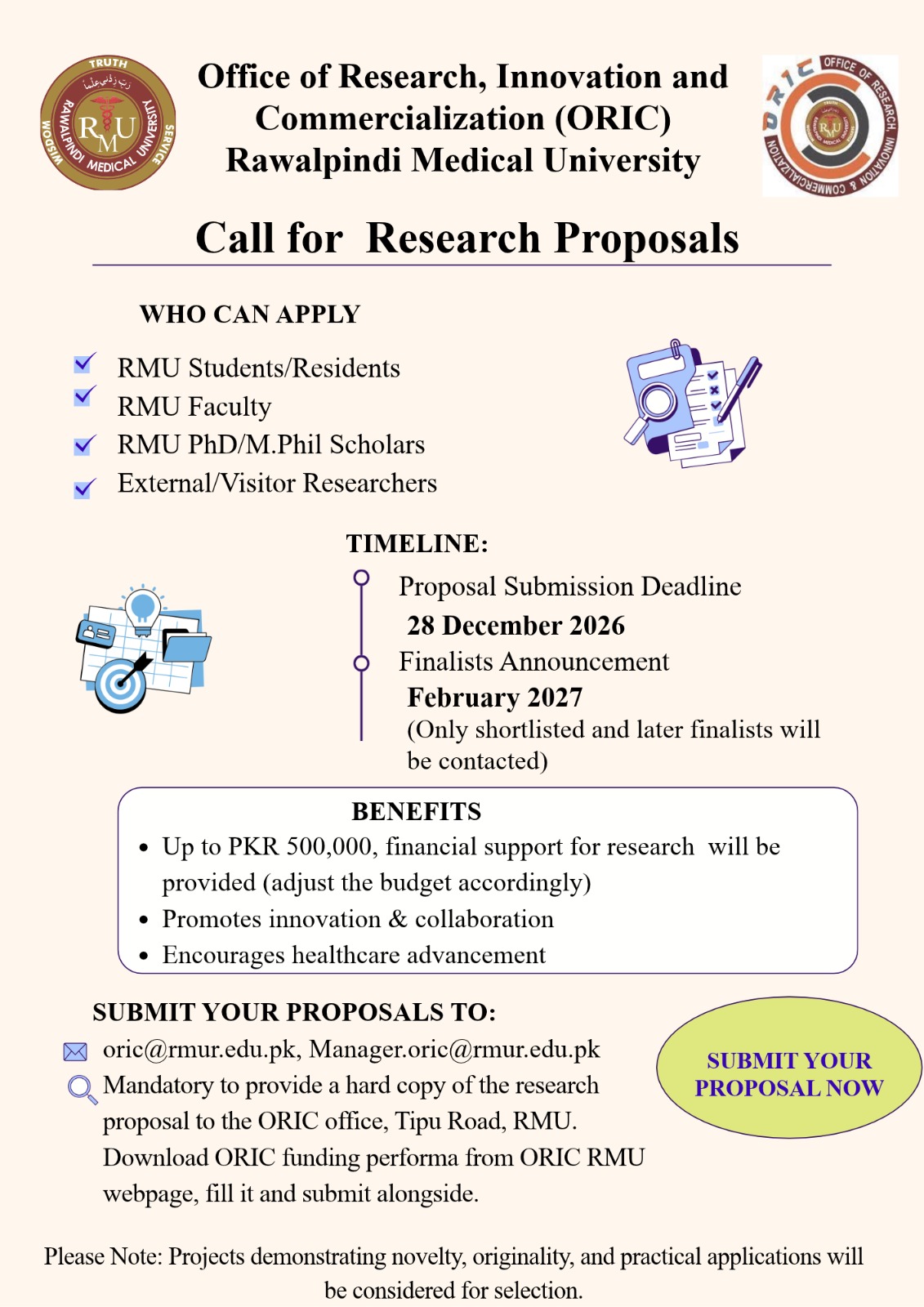
The unit is actively involved in innovative research aimed at enhancing patient care. Research topics undergo a structured approval process, progressing through the DRB, ERB, and BASR stages before data collection, thesis development, and article writing. Faculty members actively participate in various research initiatives, including the Faculty Research Forum (FRF) and the Resident Research Forum (RRF), and also serve as judges for poster presentations and research projects in the Student Research Forum (SRF) for MBBS students. Key research areas focus on emerging issues such as Placenta Accreta Spectrum (PAS), labor monitoring using the Labour Care Guide, trials of previous cesarean sections, anemia prevention in obstetric populations, and the structured follow-up of high-risk obstetric patients through the FIGO Pregnancy Passport.
The department actively participates in outreach programs, including medical duties at Adyala Jail and TB Samli Sanatorium Hospital, Murree. It also manages various administrative responsibilities, such as overseeing maternal mortality meetings, infection control, and pharmacovigilance. Additionally, the department contributes to hospital administration by participating in the Hospital Management Committee and Rats/Rodents Control Committee meetings. Senior faculty members are part of the hospital mortality committee, while faculty members also serve on inquiry committees to address and investigate complaints filed by patients and their attendants.
The faculty spearheads various university initiatives, including the DGO program, the Directorate of Assessment, the Section Editor role at JRMC, and the organization of faculty development workshops. Additionally, the unit head oversees student extracurricular activities such as the Rawalpindi Debating Order (RDO) and the Rawalian Student Research Society (RSRS). Senior faculty members serve as approved supervisors and examiners for the College of Physicians & Surgeons Pakistan, Rawalpindi Medical University, and Shaheed Zulfiqar Ali Bhutto Medical University. Faculty members actively participate in National conferences including the Society of Obstetricians & Gynaecologists of Pakistan (SOGP), the Menopause Society, and the PUGA Society, IRC RCOG summit and International conferences like RCOG and FIGO.
Excellence
We strive for the highest standards in women’s obstetrical and gynecological health care, continuously enhancing our programs and services.
Commitment
We are dedicated to evidence-based medicine, pioneering technology, and ensuring timely access to quality care.
Integrity
We uphold ethical, respectful, and collaborative practices in all aspects of our work.
Life-long Learning
We embrace continuous learning, fostering the development of skills and knowledge for both our team and the future generation of medical professionals.
Research
We are committed to globally recognized research that advances women’s health and enhances medical practices.
Collaboration
We believe that the best outcomes arise from teamwork and partnership.
Work Environment
We foster a safe, supportive, and inclusive workplace, where we look out for one another and cultivate a culture of mutual respect.
Accountability
We take responsibility for our actions, holding ourselves accountable to our patients, colleagues, and the broader community.
Service
Through leadership and excellence, we proudly serve Kingston hospitals, Queen’s University, national organizations, and—most importantly—our patients.
Diversity & Equity
We are committed to understanding and addressing the diverse needs of all patients, with a focus on providing holistic and equitable care.
Our Team

List of Researchers
PhD Researchers
- Ghazala Saleem, Associate Professor Physiology BUCM
- Tahseen, PhD Scholar in Microbiology, Rawalpindi Medical University
FCPS
- Prof. Humera Noreen
- Dr. Khansa Iqbal
- Dr. Maliha Sadaf
- Dr. Farah Deeba
- Dr. Saira Ahmed
- Dr. Amna Abbasi
- Dr. Sabeen Ashraf
- Dr. Saima Khurshid
- Dr. Saba Yousaf
- Dr. Noureen Pervaiz
- Dr. Nadia Sadiq
- Dr. Sumbal Shahzad
Research Projects
Poster Presentations
Paper Presentations
List of Events
Curriculum
Annual Report
Teaching & Assessment
Total Visitors: 10,438