Welcome To
Nursing College DHQ
Florence Nightingale was the pioneer of nursing profession and introduced the concept of modern nursing. Since then, nursing profession has been flourishing with passion. Nevertheless, the profession still holds firm to its noble value of “love” “care” and “selfless service”. Thus, nursing education plays a crucial role in meeting the health care needs of the humanity. I feel delighted to highlight that the nursing diploma has been replaced with the 4years BSc Nursing program in Pakistan.
Students are the backbone of the nation and nurses are the backbone of the healthcare system. However, moving to a new stage in life can be a challenging process. You should work hard and more focused towards your studies. May all the dreams that you hold in your heart will come true.
I wish my students the best of luck in all of your future accomplishments. Further, I extend my best wishes for success in their career effort to use their knowledge in meeting the challenges posed by the complex healthcare system.

PRINCIPAL
Vision
To establish a learning environment where knowledge is created and shared.
Mission
To prepare competent professional nurses through advanced nursing education and research who can contribute to promote health and boost the quality of life of the society.
PROGRAM OBJECTIVES
The following objectives contribute to the enhancement of the nursing profession:
- To prepare competent, committed, knowledgeable nurses.
- To educate nurses with appropriate knowledge, skills and attitudes with clinical competency.
- To produce nurses who will integrate evidence-based science into clinical practice for the care of individual, families and communities.
- To produce nurses who can provide preventive, promote, curative and
- Rehabilitative health care to populations in rural and urban settings.
- To enable nurses to meet the future challenges, including changes in technology, which confronts health care in 21st century.
- To develop human resources for as teaching faculty for existing nursing programs, as currently there is a deficiency in numbers of faculty member.
INSTITUTIONAL GOALS
- Prepare students with a quality nursing education that will provide them the opportunity to achieve career success through certification, licensure or other professional distinction.
- Promote an environment of collaboration, excellence, creativity and professional development.
- Enable students to synthesize theoretical knowledge with professional nursing.
- Provide leadership to the profession as well as in the community.
- Promote excellence in research and creative activities.
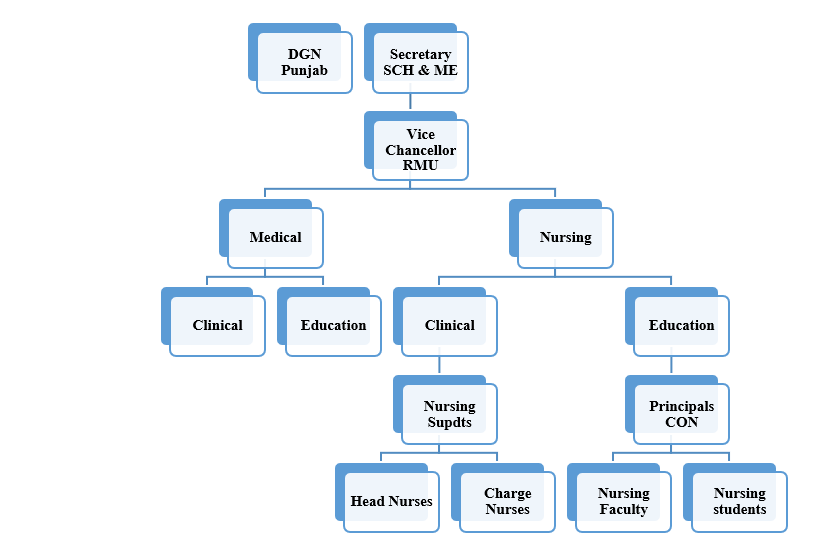
ORGANIZATIONAL STRUCTURE COLLEGE OF NURSING DISTRICT HEADQUARTER HOSPITAL RWP
Collage Of Nursing DHQ
History
- School of Nursing DHQ was established in 1988 and attached with District Headquarter Hospital Rwp.
- College Building is located in the hospital premises
- Initially General Nursing & Midwifery programs were being offered.
- SON, DHQ upgraded & notified as College of Nursing on 17th February, 2021.
- Currently offering Four Years Bachelor Degree in Nursing (50 seats) & One year Diploma in Midwifery (72 seats)
- General Nursing & Midwifery phased out & BSN Generic started in 2018.
- 1st Batch (50 students) of BSN has been enrolled in 2022.
- Annual intake of this institute is 122
- College has a furnished accommodation for students
1. Caring
Caring is the action of promoting health, healing and hope throughout the life. Philosophy of caring is fundamental to the nursing profession. It characterizes “our concern and consideration for the whole person, our commitment to the common good, and our outreach to those who are vulnerable.” (as cited in NLN 2010 p.11).
2. Communication
Communication is an essential skill to collaborate with the health care team to teach the patient and family in order to promote health, prevent illness and maintain the health of the patient to prevent reoccurrence of illness. Active listening and the exchange of verbal and nonverbal messages is key to building consensus and resolving conflict. Effective communication necessitates continuous improvement of oral, written, and computing skills in order to improve quality of care. (Amer, 2013)
3. Diversity
Diversity identifies and affirms the uniqueness of each person’s race, ethnicity, gender, sexual orientation, socioeconomic status, age, physical abilities, values, religious and political beliefs, and other ideologies. Diversity in the Nursing is essential because it provides opportunities to administer quality care to patients.
4. Ethics
“Ethics is a philosophical discipline that systematically studies what our conduct ought to be in relation to ourselves, other, and the environmental and how to justify what is right or good. Ethics addresses the whole of life, and that includes our ethical obligations as individuals, professionals, and citizens”. The professional code of ethics for the nurses gives guidance for decision making concerning ethical matters and serves for self-evaluation and reflection regarding ethical nursing practice. The code also informs other health care professionals and the public in general about the moral commitments expected of the nurses.
5. Excellence
Excellence is consistent adherence to standards of care and quality with commitment to evidence based practice.
6. Holism
It refers to the provision of care to patients that are based on a mutual understanding of their physical, psychological, emotional, and spiritual dimensions. Holistic care in nursing is a philosophy that guides the care that patients' receive which emerged from the concepts of humanism and holism. Florence Nightingale was the first nurse to emphasize the significance of holistic care in nursing.
(Jasemi, M., Valizadeh, L., Zamanzadeh, V., & Keogh, B. (2017). A concept analysis of holistic care by hybrid model. Indian journal of palliative care, 23(1), 71
7. Integrity
Integrity involves adherence to ethical professional conduct and accepting accountability for our actions while being fully committed to the betterment of patient care. “A culture of integrity is evident when organizational principles of open communication, ethical decision making, and humility are encouraged, expected, and demonstrated consistently.” (as cited in NLN 2010 p.13).
Previous
Next
Gallery


Total Visitors: 29,520